Luxury Villa Furniture Buying Guide
How to Buy Furniture for a Luxury Villa from Overseas: 12 Questions to Ask Your Manufacturer
A beautiful catalog is a start—not a buying strategy. Use these questions to protect the design, budget, schedule, and quality of your whole-villa furniture project.
Quick answer: Before buying luxury villa furniture overseas, confirm the manufacturer's project experience, design process, material specifications, sample approval, drawings, quality control, lead time, packaging, shipping terms, installation support, warranty, and change-order procedure. Get the details in writing before mass production begins.
Buying one chair online is easy. Furnishing a villa from another country is a completely different game. You may be coordinating dozens of pieces, several rooms, custom finishes, fragile stone, upholstered items, fixed joinery, international freight, and a move-in date that will not wait.
The good news? Overseas sourcing can give you more design freedom, stronger customization, and access to a complete manufacturing supply chain. The catch is that you need to ask better questions than “How much?” and “How fast?”
This guide gives villa owners, designers, architects, developers, and purchasing teams a practical checklist. It is designed to help you compare an overseas furniture manufacturer on the things that actually affect the finished interior.

Question 1Have you completed villa projects like mine?
Do not settle for a general “yes, we make furniture.” Ask to see completed projects with a similar style, property size, room count, customization level, and destination market. A supplier that mainly sells standard products may be excellent at repeat production but less experienced at coordinating an entire residence.
Look for evidence of:
Whole-house schedules covering living, dining, bedroom, study, and secondary spaces
Custom loose furniture and, if needed, fixed joinery or wall paneling
Consistent finishes across different product categories
Large or delicate pieces that required special packing and access planning
International project communication with owners, designers, or contractors
For reference, EKAR's project section includes a full-house Shanghai villa case, a custom villa woodwork and joinery project, and other residential and hospitality projects. Reviewing comparable work is much more useful than judging a factory by hero images alone.
Question 2What design support is actually included?
“Customization” can mean anything from changing a fabric color to developing an entire room from drawings. Ask the manufacturer to define the service clearly.
Will the team review floor plans? Build a room-by-room furniture schedule? Recommend dimensions? Prepare 3D renderings? Match an architect's finish palette? Coordinate loose furniture with fixed millwork? Flag pieces that cannot pass through a doorway?
A well-run project starts with requirements, moves through prototypes or samples, then proceeds to mass production, quality control, and support. That sequence is outlined on EKAR Furniture's custom furniture service page. If your project needs a coordinated classical, modern, minimalist, or mixed interior, browse the manufacturer's furniture collections to understand the range before requesting a proposal.
Buyer tip: Send one clean project brief rather than a stream of chat messages. Include floor plans, room names, required quantities, preferred dimensions, reference images, target materials, budget range, destination, and required arrival date.
Question 3What exactly is inside each piece?
Two sofas can look nearly identical on a screen and perform very differently over time. Ask for written specifications—not just finish names.
For upholstered furniture, confirm:
Frame material and construction
Foam density or seat construction
Suspension system
Fabric or leather type, grade, color code, and performance
Whether visible and non-visible leather areas use the same material
Leg or base material and finish
For casegoods and tables, confirm:
Solid wood species, veneer, plywood, MDF, or engineered board
Stone type, thickness, backing, edge detail, and natural variation
Metal grade, finish process, and color sample
Hardware brand or functional specification
Surface coating and care requirements
If responsible timber sourcing matters to the project, ask which components can use certified material and request supporting documentation. The Forest Stewardship Council notes that certified furniture and wood products can support more responsible forest management.
Use real product specifications as a starting point. For example, compare a modern leather sofa, a customizable walnut dining table, and available modern bedroom furniture. Then ask the factory to state exactly what will be supplied for your order.
Question 4Can I approve materials and a prototype before mass production?
Yes should be the expected answer. Digital screens cannot reliably show wood tone, stone movement, fabric texture, leather feel, gloss level, or metal color. Physical approval closes that gap.
At minimum, request a labeled material board with:
Wood or veneer finish
Stone or sintered-stone sample
Metal finish chip
Fabric and leather swatches
Paint or lacquer color
Handle and key hardware samples
For a signature sofa, dining table, bed, door, or repeated guest-room item, a prototype or first-article sample is worth discussing. Approve it in writing before the production team repeats it across the project.
Question 5Will I receive dimensioned shop drawings?
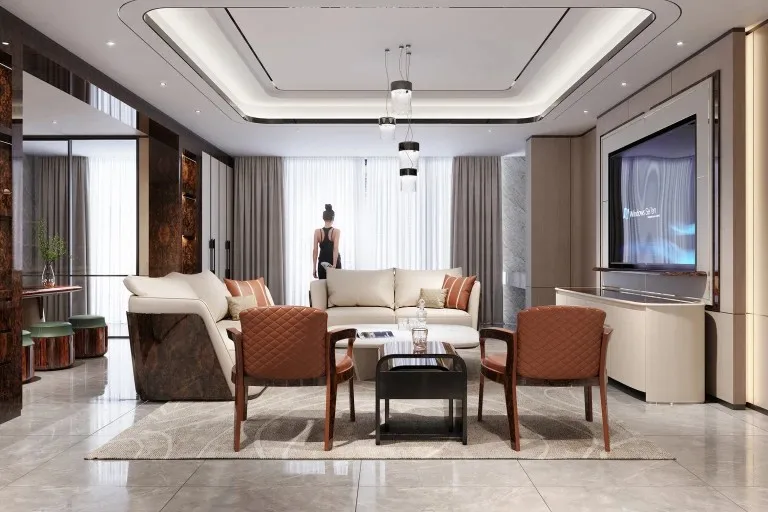
Renderings sell the idea. Shop drawings build the product. For custom pieces, request drawings that show overall dimensions, materials, finish references, construction details, hardware, electrical requirements, mounting points, and any site interfaces.
Someone on your side—the owner, designer, architect, or project manager—must approve those drawings. Check them against the latest site dimensions, not an early concept plan. This is particularly important for:
Wall-to-wall joinery and wardrobes
Large dining tables and sectional sofas
Built-in lighting, power, or charging
Headboards aligned with outlets and switches
Furniture that must fit elevators, stairs, or narrow doors
Question 6How do you control quality during production?
A final inspection is important, but it is too late to discover that the wrong veneer, foam, or internal structure was used. Ask for quality checks at several stages.
| Stage | What to verify | Useful evidence |
|---|---|---|
| Incoming materials | Wood, board, stone, metal, upholstery, hardware | Material labels, photos, sample comparison |
| Frame and structure | Dimensions, joints, reinforcement, stability | In-process photos and measurement records |
| Finishing and upholstery | Color, sheen, stitching, grain direction, comfort | Approved-sample comparison and close-up images |
| Final assembly | Function, alignment, hardware, wobble, damage | Inspection checklist and videos |
| Packing | Protection, labels, parts, hardware, crate condition | Packing photos and package list |
For higher-value orders, consider an independent pre-shipment inspection. The key is to define acceptance criteria before production—not after the container is ready.
Question 7What is the real production and delivery timeline?
Ask for milestones, not one hopeful date. A realistic schedule may include design development, quotation approval, sample preparation, material sign-off, shop drawings, prototype approval, mass production, inspection, packing, export booking, sea freight, customs, local delivery, and installation.
Also ask which events can change the schedule. Imported fabric, custom metalwork, natural stone selection, revised drawings, peak-season capacity, and delayed approvals can all affect timing.
Red flag: A supplier promises a very short lead time before reviewing quantities, materials, customization, and approvals. Fast can be real for stock items; it should not be assumed for a complex villa package.
Question 8How will fragile and oversized furniture be packed?
Great furniture can arrive damaged if the packaging plan is treated as an afterthought. Ask how the factory protects corners, legs, glass, marble, mirrors, polished metal, carved surfaces, and light-colored upholstery.
Confirm whether pieces will use cartons, foam, edge protectors, moisture barriers, wooden crates, or knock-down packing. Every package should have a clear code linked to the room and item schedule. Small hardware needs its own labeled pack, ideally secured to the correct item.
The International Safe Transit Association explains that pre-shipment testing helps evaluate how well packaging protects products during distribution. You may not need a laboratory test for every custom piece, but the manufacturer should be able to explain the hazards considered and the protection used.
Question 9What do the price and shipping terms include?
A low quote can become expensive when key costs sit outside it. Ask whether the price includes samples, drawings, taxes, export packing, inland transport, loading, export customs, ocean freight, insurance, destination charges, import duties, local delivery, unloading, assembly, and installation.
Then confirm the agreed Incoterm and named place. The International Chamber of Commerce states that Incoterms® 2020 help define buyer and seller obligations, costs, and risks. “FOB,” “CIF,” “DAP,” or another term should never appear without the correct named port or place and a clear understanding of what happens next.
Ask for these documents before shipment
Commercial invoice
Packing list with package dimensions and weights
Product and room codes
Bill of lading instructions
Certificate or origin documents if required
Material declarations or compliance documents required by the destination
Inspection and packing records
Question 10What installation support will you provide?
Some furniture only needs unpacking and leg assembly. Other pieces require wall fixing, stone joining, electrical connection, level adjustment, or coordination with site joinery. Define the scope before ordering.
Ask whether the manufacturer provides assembly drawings, installation videos, labeled hardware, spare fittings, remote guidance, or an installation team. If a local contractor will install the furniture, send the instructions early enough for them to review tools, manpower, access, and site readiness.
Question 11What happens if something arrives damaged or incorrect?
Do not wait for a problem to discover the after-sales process. Ask for written terms covering transport damage, manufacturing defects, color variation, missing parts, incorrect dimensions, and warranty claims.
Clarify:
How quickly damage must be reported
Which photos, videos, labels, and packaging records are required
Who files the freight or insurance claim
Whether the remedy is repair parts, local repair cost, remake, credit, or replacement
How replacement items will be shipped
Whether spare fabric, leather, stone, finish, and hardware will be supplied
Photograph the container or truck seal, unloading process, unopened packages, labels, and any visible damage. Keep the packaging until the claim procedure is confirmed.
Question 12How are design changes, substitutions, and extra costs approved?
Villa projects evolve. A room dimension changes. A fabric becomes unavailable. The owner selects a different stone. The safest process is a written change order that states what changed, why, the cost difference, and the schedule impact.
Ask the manufacturer not to substitute materials, hardware, colors, or construction without written approval. Keep one current version of the furniture schedule and mark superseded drawings clearly. A simple approval log can prevent an expensive argument months later.
What should a complete villa furniture quotation contain?
A professional quotation should make comparison easy. At minimum, it should identify:
Room name and item code
Product image or drawing reference
Quantity and final dimensions
Material and finish specification
Unit and total price
Customization included
Sample or drawing charges
Packing method
Production lead time
Incoterm and named place
Payment schedule
Quotation validity and exclusions
If you want one supplier to coordinate the entire home, review the breadth of its catalog: modern living room furniture, dining room furniture, bedroom furniture, customized furniture, and top luxury collections. Range alone is not enough, but it shows whether the factory can coordinate styles and finishes across multiple rooms.
How do you compare overseas furniture manufacturers fairly?
Send the same brief to each shortlisted supplier. Then compare like for like—not just the final total.
| Compare | Strong answer | Weak answer |
|---|---|---|
| Project fit | Relevant completed cases and a clear project team | Only generic catalog images |
| Specification | Materials, dimensions, finishes, and construction in writing | “High quality” without measurable detail |
| Approval process | Samples, drawings, sign-offs, and version control | Production based mainly on chat messages |
| Quality control | Checks during production plus final inspection | Inspection only after packing |
| Logistics | Clear packing plan, documents, Incoterm, and responsibilities | One freight number with unclear exclusions |
| After-sales | Written claim process, warranty, and spare-part plan | “Do not worry, we will handle it” |
EKAR Furniture describes a one-stop process from design and development through production and sales, with experience serving residential and hospitality projects from its Foshan manufacturing base. Buyers can review the company's factory profile, customization process, and villa cases before starting a detailed project discussion.
Frequently asked questions about buying villa furniture overseas
What should I ask an overseas furniture manufacturer before ordering for a villa?
Ask about project experience, design support, material specifications, samples, shop drawings, quality control, production timing, packaging, Incoterms, installation, warranty, and change management. Get each answer in writing before paying the production deposit.
How long does custom villa furniture production take?
Timing depends on design approval, materials, order size, sampling, and factory capacity. Ask for a milestone schedule covering drawings, samples, material approval, production, inspection, packing, and shipment rather than one vague delivery date.
Should I request furniture samples before mass production?
Yes. At minimum, approve physical finish samples for wood, stone, metal, fabric, and leather. For important or repeated pieces, request a prototype or first-article sample before authorizing mass production.
How can I check furniture quality before overseas shipping?
Use approved drawings and samples as the inspection standard. Request in-process photos, dimension checks, material verification, functional testing, packing photos, and a final inspection report. A third-party inspection can add independent verification.
Which shipping terms should I use when buying furniture overseas?
The right Incoterm depends on who will manage export clearance, freight, insurance, import customs, duties, and final delivery. Confirm the named place and exact Incoterms® 2020 rule in the contract so costs and risks are clear.
Can one manufacturer furnish an entire luxury villa?
Yes, if the supplier can coordinate loose furniture, custom sizing, finishes, upholstery, fixed joinery, drawings, production, quality control, packing, and installation information across rooms. Review completed whole-house projects before selecting a partner.
The best overseas order is the one with fewer surprises
Choosing a furniture manufacturer is not just choosing a style. You are choosing a project process. The strongest partner will help turn inspiration into approved specifications, controlled production, protected packages, clear shipping responsibilities, and usable installation information.
Ask the 12 questions early. Put the answers in the quotation and contract. Approve the samples and drawings carefully. That extra discipline is what helps a villa arrive looking like one complete interior—not a collection of expensive misunderstandings.
Planning a luxury villa furniture project?
Share your floor plans, room schedule, reference images, destination, and target timeline with EKAR Furniture for a coordinated project proposal.
Discuss Your Villa Furniture Project


 +86-757-82718320
  +86-18024171164/18029302317
 live:ekarfurniture
 +86-18024171164/18029302317